

Table of Contents
- Why Confidentiality Matters in Health Care
- Common Mental Health Challenges in High-Pressure Roles
- Privacy and Discretion in Mental Health Care
- Telehealth: Privacy and Convenience
- How to Evaluate and Choose a Mental Health Provider
- Taking the First Step: The Initial Consultation
- Privacy Is Personal
- Frequently Asked Questions
Last Updated: September 1, 2026
Confidential Mental Health Care for Executives
Executives and other professionals in high-pressure roles may have particular reasons to think carefully about privacy when seeking mental health care. But wanting control over personal health information is hardly unusual. Mental health care is health care, and privacy matters whether you’re discussing your physical health, emotional well-being, medication, or any other aspect of your care.
Here, we look at what confidentiality means in mental health care, where its protections have limits, and what to consider when choosing care that fits your needs and preferences.
Why Confidentiality Matters in Mental Health Care
Privacy is a reasonable expectation in health care. Most of us want some control over who has access to personal information about our health and when that information is shared. That expectation doesn’t change when the care involves mental health.

For executives and professionals in high-pressure roles, privacy may sometimes receive additional consideration because of leadership responsibilities, professional visibility, or the boundaries they want to maintain between their personal and professional lives. Those circumstances can make discretion particularly valuable, but the underlying desire for privacy is something most people share.
Mental health professionals have legal and professional responsibilities concerning the privacy and confidentiality of patient information. Those protections are significant, but confidentiality does not mean that information can never be disclosed. Certain disclosures may be permitted or required by law, and patients may also authorize information to be shared for particular purposes.
Understanding those boundaries can make confidentiality more useful rather than less reassuring. You can ask a clinician how records are maintained, who may have access to them, under what circumstances information may be disclosed, and what happens when another organization, such as a health plan, becomes involved in your care.
Confidentiality can also support the clinical relationship itself. Mental health care often involves conversations about experiences, thoughts, relationships, behaviors, or concerns that may be difficult to discuss. Understanding how your information is protected can help create an environment in which you feel more comfortable speaking openly with your clinician.
Common Mental Health Challenges in High-Pressure Roles
The demands associated with leadership and other high-pressure roles can affect different people in different ways. Long hours, significant responsibility, difficult decisions, travel, and competing professional and personal demands can all become part of the context in which mental health concerns emerge or become more noticeable.
Changes in focus, energy, sleep, or mood may be among the first things someone notices. Anxiety can begin affecting decisions or making it harder to disengage from work. Others may notice irritability, diminished enjoyment, persistent worry, changes in relationships or coping habits, or that maintaining their usual pace requires more effort than it once did.
None of these experiences is unique to executives or professionals. And continuing to perform well at work does not necessarily answer questions about sleep, mood, attention, anxiety, relationships, or well-being. If something has changed or a pattern has become concerning, exploring it with a qualified mental health professional can help you better understand what may be happening.
Privacy and Discretion in Executive Mental Health Care
Mental health care is health care, and confidentiality is an important part of both. Whether you use insurance or pay for care directly, privacy and confidentiality requirements protect your health information. The difference with insurance-independent care is not that confidentiality suddenly begins, but that paying directly can reduce some of the administrative information-sharing involved in submitting and processing an insurance claim.
For people who place a high value on discretion, that may be meaningful. Others may be comfortable using insurance and relying on the privacy protections already in place. Neither choice is inherently right for everyone.
Privacy is also only one consideration when choosing care. An insurance-independent model may give a practice greater flexibility in how it structures appointments, follow-up, and treatment. What matters is understanding the particular provider’s approach rather than assuming that every private-pay or insurance-based practice operates the same way.
Depending on the practice, insurance-independent care may offer:
- Fewer administrative information-sharing touchpoints
- Greater flexibility in appointment length and scheduling
- More flexibility in how follow-up care is structured
- Treatment decisions without insurance authorization requirements
HarmonyMBS is an insurance-independent practice providing secure telehealth to adults throughout California. Our model is designed around thoughtful evaluation, unhurried appointments, collaborative decision-making, and care responsive to the individual.
Telehealth for Professionals: Privacy and Convenience
Telehealth can make mental health care easier to fit into a demanding schedule while giving you more control over where you receive care.
Telehealth for Professionals: Privacy and Convenience
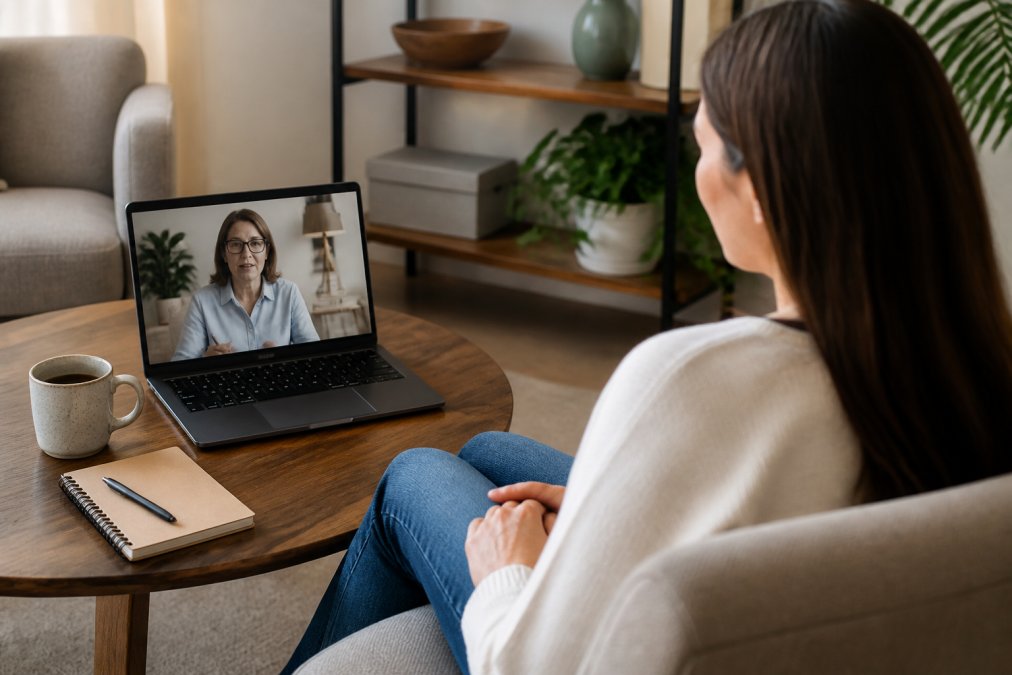
Telehealth can make mental health care easier to fit into a demanding schedule while giving you more control over where you receive care. Instead of traveling to an office, you can meet with your clinician from an appropriate private location, as long as you are physically located where your clinician is authorized to provide care.

For professionals balancing work, travel, and other responsibilities, eliminating the trip to and from an office can make scheduling care more manageable. Telehealth also offers a practical form of discretion: there is no mental health office or waiting room to enter, and you can choose a setting where you feel comfortable having a private conversation.
Technology matters, too. Mental health practices should use telehealth systems and procedures appropriate for protecting health information. Patients can support their own privacy by choosing a private setting and considering who may be able to hear or access the device or network they are using.
HarmonyMBS provides secure, HIPAA-compliant telehealth to adults throughout California. Our platform allows patients to receive care from a private location that works for them while maintaining the continuity and personal attention central to our approach.
How to Evaluate and Choose a Mental Health Provider
When executives consider mental health care, remember that choosing a provider involves more than reviewing credentials. Privacy, clinical approach, communication style, logistics, and your experience of the interaction can all help you determine whether a clinician and practice are a good fit.
| Evaluation Criterion | What to Look For | Why It Matters |
|---|---|---|
| Practice structure | Understand whether the practice accepts insurance, is insurance-independent, or offers private-pay options | Helps you understand how payment and insurance may affect administrative information-sharing |
| Clinical experience | Appropriate credentials and relevant experience with concerns like yours | Helps you determine whether the clinician’s background fits the care you are seeking |
| Appointment structure | Enough time for the purpose of the appointment and a clear explanation of how evaluation and follow-up are structured | Helps you understand whether the practice allows appropriate time to explore your concerns and circumstances |
| Treatment and medication approach | Treatment options explained clearly, with medication considered as one option when appropriate and your questions and preferences taken into account | Helps you understand how the clinician approaches prescribing and supports informed, collaborative treatment decisions |
| Telehealth and logistics | A secure, HIPAA-compliant telehealth platform and clear policies for scheduling, communication, and virtual appointments | Helps you understand how care works in practice and how your privacy is supported |
| Record handling | Clear information about documentation, access, and authorized disclosure | Helps you understand what is recorded and how your health information is handled |
| Therapeutic relationship | A clinician who listens, asks thoughtful questions, explains their thinking, and respects your agency | Feeling heard and respected can support open communication and collaborative care in the clinical relationship |
Credentials matter, but so does fit. An initial conversation can help you understand how a clinician communicates, how the practice operates, and whether the approach feels appropriate for what you are looking for.
Taking the First Step: The Initial Consultation
An initial consultation can give you and a prospective clinician an opportunity to begin discussing what brings you to care, ask questions, and consider whether the clinician and practice may be a good fit.
At HarmonyMBS, care begins with an Initial Consultation. This preliminary conversation gives you an opportunity to share what has been going on and what changes you may have noticed, ask questions, learn about our approach to care, and get a sense of whether the clinician may be a good fit for you.
If you decide to continue care, the next step is a Comprehensive Psychiatric Evaluation. This is the more in-depth clinical evaluation in which your clinician explores your symptoms, health and treatment history, current circumstances, goals, and other factors that may help inform care.
Privacy Is Personal
Some people are comfortable relying on the confidentiality protections already built into health care, while others prefer additional discretion in how they seek and pay for care. Understanding your options can help you choose an approach that fits your preferences as well as your mental health needs.
HarmonyMBS provides insurance-independent mental health care through secure, HIPAA-compliant telehealth to adults throughout California. Patient health information and clinical records are maintained within our secure electronic health record system, with safeguards designed to protect health information and support appropriate access. Secure patient-portal messaging also provides a protected way to communicate with our practice between appointments. Our approach emphasizes thoughtful evaluation, collaborative decision-making, continuity, and respect for your privacy and preferences. Explore Our Approach to learn more about how we work and consider whether HarmonyMBS may be a good fit for you.
Frequently Asked Questions
Q: How is my privacy protected when I receive mental health care?
A: Mental health care is health care, and your health information is subject to privacy and confidentiality protections. Mental health practices should have safeguards governing how records are maintained, accessed, and shared. These protections are significant, but confidentiality is not absolute. Information may be disclosed when authorized by you or when permitted or required by law. If privacy is especially important to you, ask a prospective practice how it maintains records, communicates with patients, and handles requests for information.
Q: What are the benefits of insurance-independent mental health care?
A: Insurance-independent care allows you to pay a practice directly without submitting a claim to your health plan. For people who value additional discretion, that can reduce some of the administrative information-sharing involved in insurance claims. Depending on the practice, insurance independence may also allow greater flexibility in appointment structure, follow-up, and treatment decisions without insurance authorization requirements. These benefits vary by practice, so it is worth asking how a particular provider structures care.
Q: How can telehealth support privacy and flexibility?
A: Telehealth allows you to meet with your clinician without traveling to a physical office, which can make mental health care easier to fit around work and other responsibilities. It also lets you choose an appropriate private setting for the conversation. Secure telehealth technology and appropriate privacy practices help protect health information, while patients can support their own privacy by considering their surroundings, device, and network. You generally must be physically located in a jurisdiction where your clinician is authorized to provide care at the time of the appointment.
Q: What should I look for when choosing a mental health provider?
A: Look for appropriate credentials and experience relevant to the care you are seeking, along with clear information about privacy, records, telehealth, communication, and how care is structured. Consider how the clinician approaches evaluation and treatment decisions and whether your questions and preferences are taken seriously. Fit matters, too. You should feel comfortable asking questions, discussing concerns, and participating in decisions about your care.
Is mental health care confidential if I use insurance?
Using health insurance does not mean your mental health care is no longer confidential. Privacy protections still apply. However, using insurance generally requires certain information to be shared for purposes such as claims processing, payment, or administering benefits. Paying directly for care can reduce some of those administrative information-sharing touchpoints, which may matter to people who prefer additional discretion.